

2 Days 1 Night Team Building Malaysia: HR Planning Guide
A practical guide to planning a 2D1N corporate programme—from agenda and accommodation to meals, transport, facilitation and HRD Corp considerations.

Planning a 2 days 1 night team building programme in Malaysia requires more than choosing a resort and several activities. HR and Admin teams need to connect the programme objective with the right agenda, accommodation, meals, transportation, participant requirements, facilitation and contingency planning.
A well-planned 2D1N programme gives participants more time together than a standard one-day event, but it also creates additional operational decisions. This guide explains what to prepare, how a practical two-day flow can be structured, and when an overnight programme makes sense for your organisation.
Companies that are already exploring a structured corporate team building programme can use this guide as a planning checklist before requesting a proposal.
A 2 days 1 night team building programme combines structured team activities, facilitated learning and informal bonding across two days with an overnight stay. It is most useful when a company wants more programme depth than a one-day event and has enough time and budget to coordinate accommodation, meals, transport and participant logistics.
1 Night
Interaction
Logistics
Accommodation
1. What Is a 2 Days 1 Night Team Building Programme?
A 2D1N team building programme is an overnight corporate programme that spreads team activities, facilitated learning and relationship-building across two consecutive days.
Compared with a short activity session, the additional time allows the programme to move through several stages: participants arrive and settle in, build familiarity, complete structured challenges, reflect on what happened, interact more casually in the evening, and return for another activity or learning block the following day.
The overnight component itself is not the objective. The value comes from having enough time to design a programme around a clear organisational need such as communication, collaboration, cross-department connection, employee engagement or rebuilding team relationships.
2. 1-Day vs 2D1N Team Building: Which Should HR Choose?
Neither format is automatically better. The right choice depends on how much time the organisation needs to achieve the programme objective and how much operational complexity the team can support.
| Planning Factor | 1-Day Programme | 2D1N Programme |
|---|---|---|
| Time Together | Focused programme within one working day. | More time for activities, reflection and informal interaction. |
| Programme Depth | Best when objectives can be addressed within several activity blocks. | Suitable when the programme needs a longer progression across two days. |
| Accommodation | Normally not required. | Room allocation, check-in and overnight requirements must be planned. |
| Meals | Usually lunch and refreshments. | May involve lunch, dinner, breakfast and refreshments depending on scope. |
| Transport | Often simpler if the venue is near the workplace. | More important when the programme is held at a retreat destination. |
| Planning Complexity | Lower. | Higher because programme and hospitality logistics need to work together. |
2D1N More time for activities, reflection and informal interaction.
2D1N Allows a longer programme progression across two days.
2D1N Requires room allocation, check-in and overnight coordination.
2D1N Programme and hospitality logistics must be coordinated together.
If your organisation mainly needs an energising employee engagement day, a one-day programme may be enough. If the objective requires more interaction, a change of environment and additional time together, a 2D1N format may be worth considering.
3. What Can a 2D1N Team Building Agenda Look Like?
A practical 2D1N agenda should balance activities with meals, rest, participant movement and facilitated reflection instead of filling every available hour with games.
The sample below is a planning reference only. The actual programme should be customised according to group size, objective, participant profile, location, travel time and venue restrictions.
4. What Should HR Prepare Before Requesting a Quotation?
The more clearly HR defines the basic programme requirements, the easier it is for a provider to recommend an appropriate programme direction and scope.
Decide whether the priority is communication, engagement, collaboration, team bonding, leadership or another organisational need.
Provide an estimated participant number even if the final attendance has not yet been confirmed.
Include one preferred date and alternative dates where possible, especially for programmes requiring accommodation.
Decide whether the organisation has its own venue, preferred area, or needs suggestions for a suitable location.
A realistic working range helps determine programme format, logistics and accommodation options.
Consider age range, departments, physical requirements, accessibility and other participant needs.
Prepare estimated room requirements and any important room-sharing or participant considerations.
Identify dietary restrictions, meal requirements and prayer-time considerations early.
HR teams can also review GenBijak's corporate retreat planning content when the event includes a stronger retreat or offsite component.
5. How Should Accommodation, Meals and Transport Be Planned?
Overnight team building adds a hospitality layer to event planning, so programme activities and participant logistics need to be planned together.

Accommodation and Room Planning
Confirm the number of participants, room-sharing arrangement, check-in and check-out timing, and whether participants have requirements that could affect room allocation. These details can influence both programme timing and overall event logistics.
Meals, Dietary Requirements and Prayer Time
Meal timing should work around the activity schedule rather than interrupt it. HR should collect dietary requirements early and confirm appropriate prayer breaks and facilities where relevant.
Transportation and Arrival Flow
If participants are travelling together, departure time, pickup point, estimated journey duration and arrival flow should be included in the programme plan. Travel time becomes especially important when considering destinations outside central KL or Selangor, including retreat areas such as Janda Baik.

Weather and Backup Planning
If outdoor activities are included, confirm what happens if weather conditions make the planned activity unsuitable. A good programme should have an alternative flow that still supports the same learning or engagement objective where reasonably possible.
6. How Should Activities and Facilitation Be Designed?
Activities should support the programme objective instead of becoming a disconnected list of games.
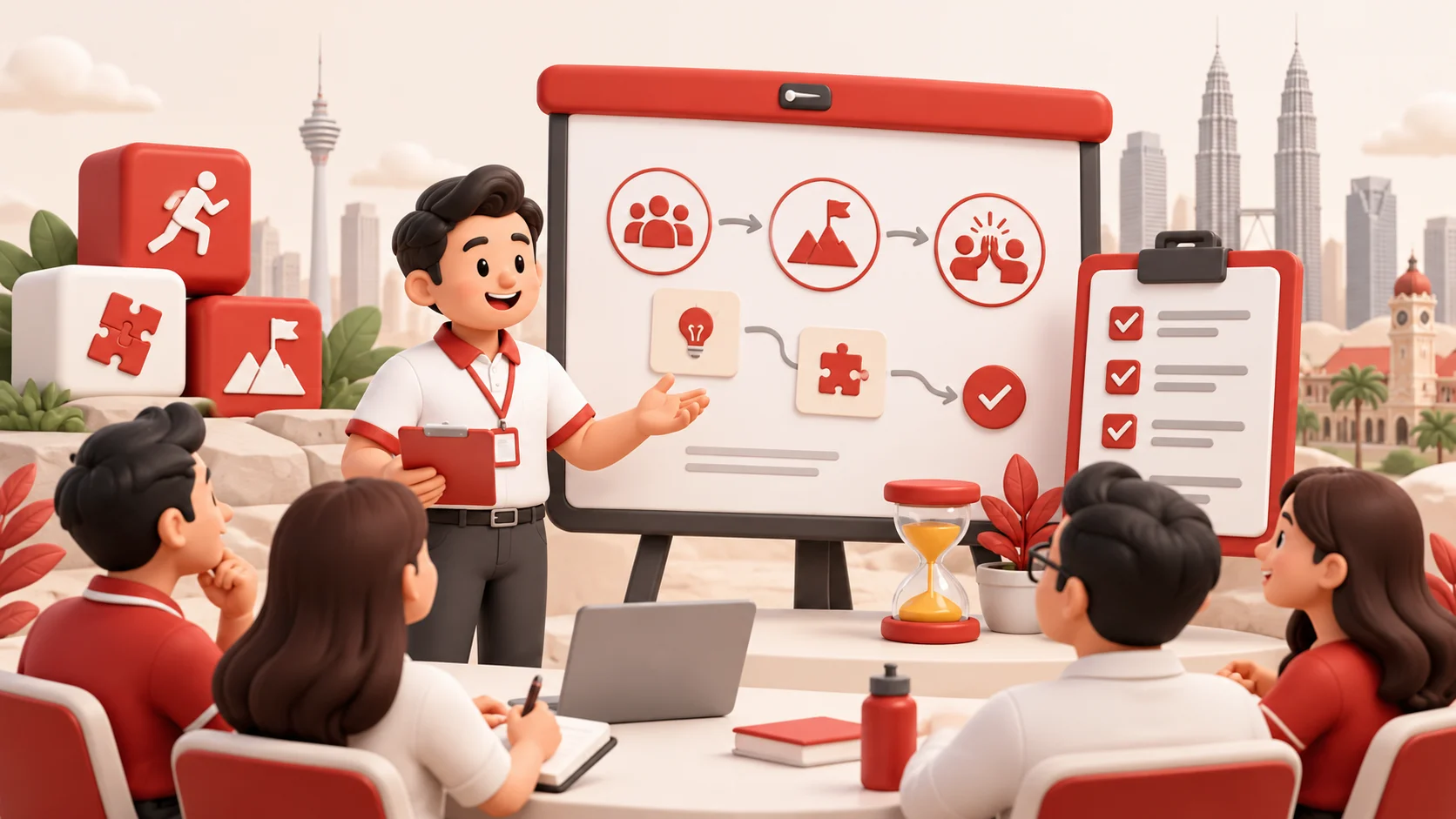
For example, a company that wants departments to communicate more effectively may need activities that require information sharing, coordinated decision making and interdependent roles. A team that has recently been formed may instead benefit from activities designed around familiarity, trust and collaborative problem-solving.
This is where facilitation matters. After an activity, participants should have an opportunity to understand what happened, what behaviours helped or hindered the team, and how those observations relate to their workplace.
- Define the desired behaviour or outcome before selecting activities.
- Match physical intensity to the participant profile.
- Plan transitions, hydration, meals and rest time.
- Include reflection or debriefing where appropriate.
- Avoid filling the agenda purely to make the programme look busy.
7. Can a 2D1N Team Building Programme Be HRD Corp Claimable?
A programme may potentially fall within HRD Corp claimable training arrangements when the employer, programme and costs meet the applicable requirements, but an overnight format by itself does not make a programme claimable.
Important HRD Corp Planning Note
GenBijak can support HRD Corp claimable programme planning for eligible employers, subject to current HRD Corp requirements, programme approval, supporting documents and available levy balance.
Employers should verify the latest rules, eligible costs and application requirements before confirming programme arrangements.
Current HRD Corp information for Claimable Courses identifies documents such as a quotation or invoice, training schedule or course content and trainer profile as part of the application process. Depending on the applicable scheme and current Allowable Cost Matrix, certain related costs may also have specific eligibility requirements.
Because rules and allowable costs can change, HR should treat claim planning as a separate compliance step rather than assuming every accommodation, meal, transportation or event cost will automatically be reimbursable.
For more focused information, review GenBijak's HRD Corp claimable team building guide .
8. How Can GenBijak Support a 2D1N Corporate Programme?
GenBijak can support companies by coordinating the programme elements around the organisation's objective, headcount, venue, duration and agreed scope.
Depending on the confirmed programme, this can include programme planning, professional trainers or facilitators, activity coordination, transportation arrangements, hotel or resort coordination, meals and event logistics.

The starting point does not need to be a completed itinerary. HR can begin by sharing the organisation's objective, estimated headcount, preferred date, preferred location and budget direction. From there, the programme scope can be discussed more practically.
9. Frequently Asked Questions
What is a 2 days 1 night team building programme?
A 2 days 1 night team building programme is an overnight corporate programme that combines structured team activities, facilitated learning, informal interaction, meals, accommodation and a second day of activities or reflection.
Is a 2D1N programme better than a 1-day team building programme?
Not always. A 2D1N format gives teams more time for deeper interaction and a wider programme flow, while a 1-day format may be more suitable when time, budget or employee availability is limited.
What should HR prepare before requesting a 2D1N team building quotation?
HR should prepare the programme objective, estimated headcount, preferred date, location or destination, budget direction, participant profile, accommodation requirements, transport needs, dietary requirements and any accessibility considerations.
Can GenBijak coordinate accommodation, transport and meals?
GenBijak can support programme planning, facilitation and event coordination, including hotel or venue, transportation and meal coordination where these items are included in the agreed programme scope.
Can a 2D1N team building programme be HRD Corp claimable?
Potentially, depending on the programme structure, employer eligibility, current HRD Corp requirements, grant approval, supporting documents, allowable costs and available levy balance. Employers should verify the latest requirements before confirming the programme.
How early should HR start planning an overnight team building programme?
Earlier planning is recommended for overnight programmes because accommodation, room allocation, transport, meals, participant information and activity spaces normally require more coordination than a single-day event.
References & Planning Sources
- GenBijak — Team Building programme and coordination information.
- GenBijak — Corporate Retreat Malaysia planning content.
- HRD Corp — HRD Corp Claimable Courses information and current application requirements.
HRD Corp requirements, allowable costs and procedures may change. Employers should confirm the latest official requirements before submitting a grant application or committing to claim-related programme costs.